
From Land Theft to Land Justice: why the Land Back movement matters for people and place
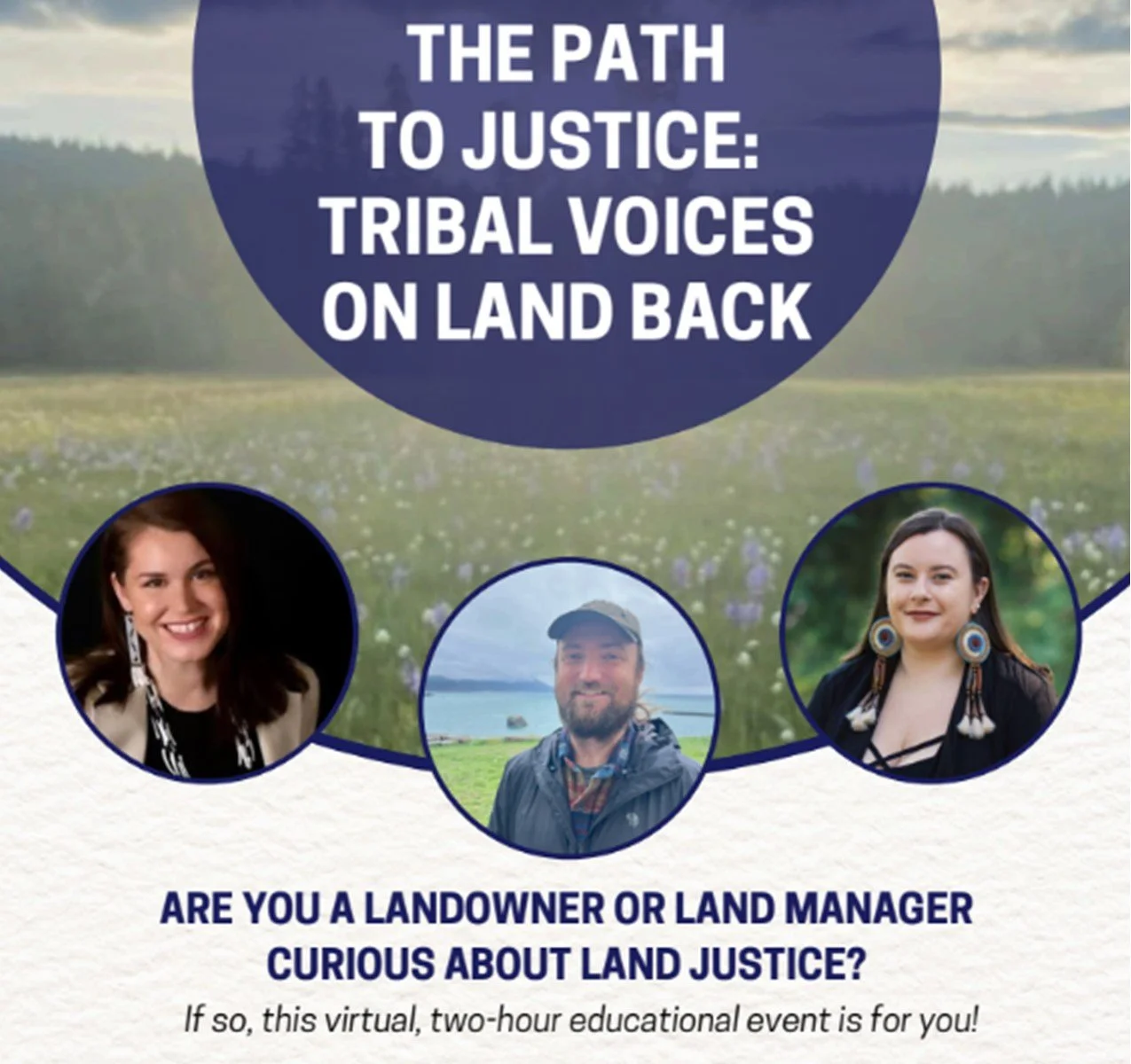
On February 19th 2026, we hosted a panel discussion (available to view on our Youtube channel) The Path to Justice: a panel discussion of Tribal Voices on Land Back. Thank you to everyone that attended, and extra big thank you to the leaders on the panel who took the time to share their work and perspectives.
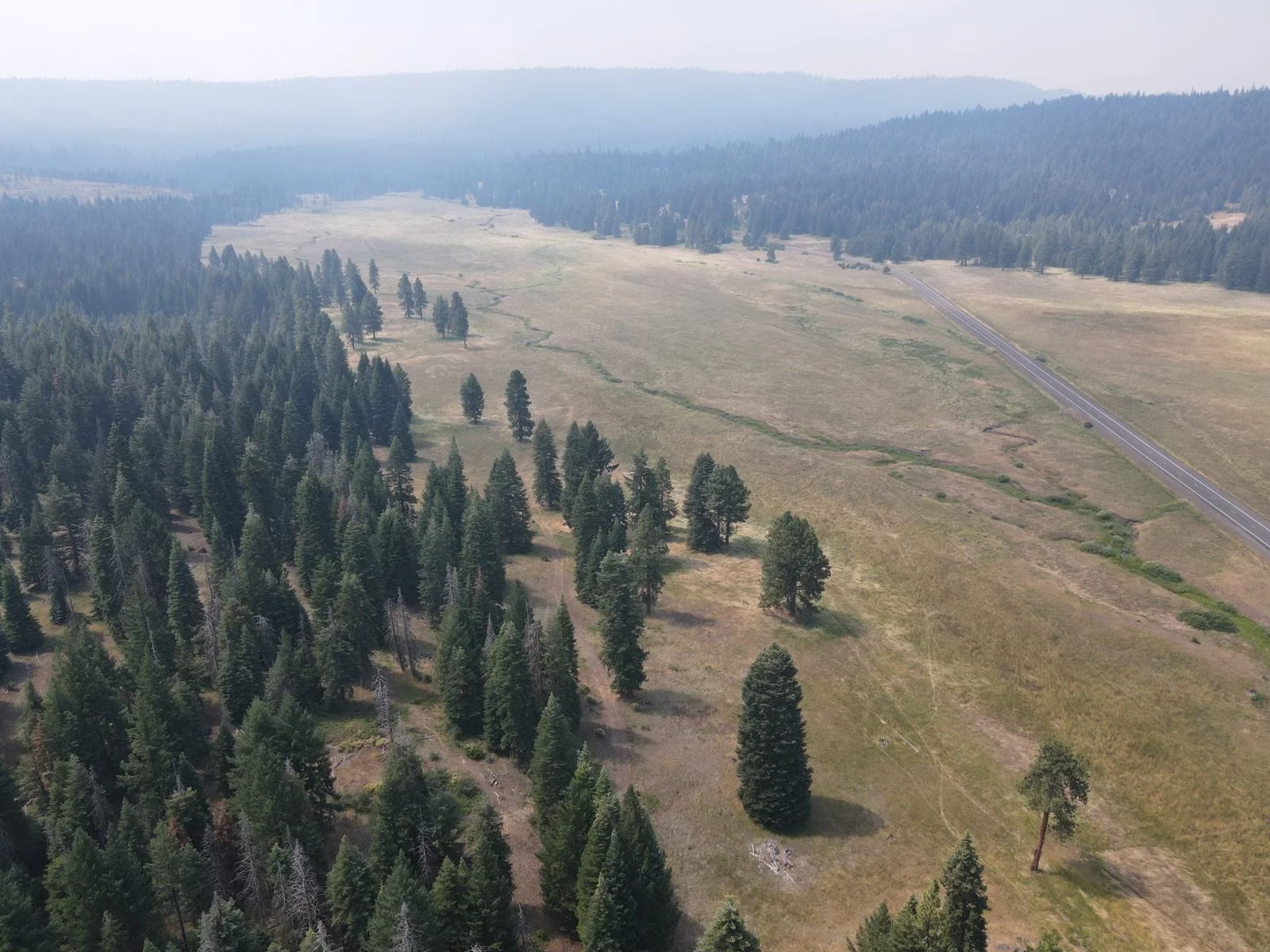
An aerial shot of Vesper Meadow Restoration Preserve
The Vesper Meadow Restoration Preserve comprises just under 1,000 acres of land, which is about 0.0002% of the 2.27 billion acres that constitutes the land mass known as North America. Comparatively speaking, America has about the same land mass as China. While the land we steward at Vesper Meadow constitutes a fraction of our country's land mass, we take the responsibility of our stewardship in the present time to heart and with the intention to learn from the descendants of the original stewards of this place - our tribal partners. This blog post will explore how Indigenous people were systematically dispossessed of 2.27 billion acres now known as America, the emergence of land justice, and why the Land Back movement is important for both people and place.
A short history of land injustice
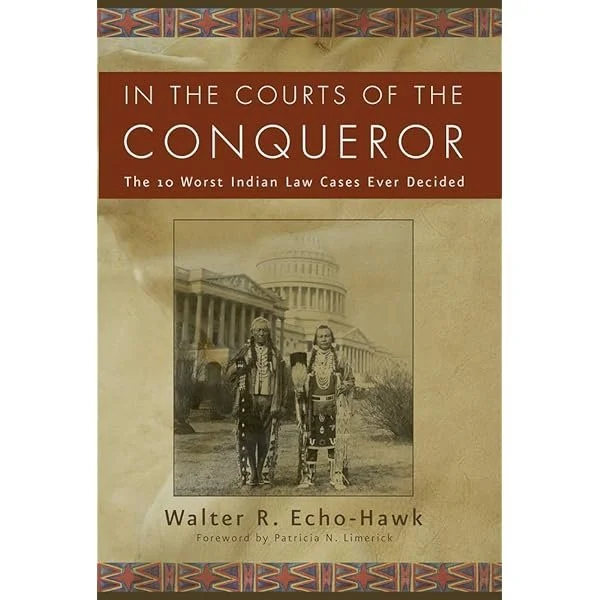
For more in-depth reading on Indian Law Cases, we recommend In the Courts of the Conqueror by Walter R. Echo-Hawk
When settlers arrived and established their first colony in 1607 on the east coast, it was not long until they realized the land they arrived at was already extensively occupied. While the British Kingdom recognized that the Indians owned the land, that did not stop settlers from initiating black market land sales prior to the founding of America. Fifty years after the signing of the Declaration of Independence in 1776, a milestone case law, Johnson v. M’Intosh, was passed in 1823 in the US Supreme Court. This precedent ruled that the Indigenous people had right of occupancy, but not full ownership of the land they had resided on for thousands of years - in effect making land theft legal.
Other Supreme Court case decisions that set precedent for land theft included the ruling that Tribes were “domestic dependent nations” (Cherokee Nations v Georgia - 1831), and ruling that Congress had permission to break treaties with Tribes whenever it wanted to (Lone Wolf v. Hitchcock - 1903). Other factors that contributed to land loss was the Indian Removal Act, signed by President Andrew Johnson in 1845 that authorized the forced removal or relocation of Native people from their original homelands, and the Termination Era of 1945 - 1968, which resulted in legal erasure for Tribes and further land loss of established reservations.
These case law precedents, working hand in hand with racist perspectives and settler colonial worldviews, led to the fastest ecological shift in human history; a shift from thousands of years of place-based, polycultural stewardship to 400+ years of extractive, profit-focused land use.
“a shift from thousands of years of place-based, polycultural stewardship to 400+ years of extractive, profit-focused land use.”
Examining land justice
A broad definition of land justice is about providing access and resources for oppressed peoples who have not been given the same access to land throughout the creation of America, and the power and wealth that comes with land.
With regards to original peoples, land justice means even more; it is about reparations for stolen land. About 2 - 2.5 % of land in America (approximately 56 million acres) is held in trust by the US Government for federally recognized Tribes, often called reservations, rancherias, pueblos, or villages. While land that is held in trust supports sovereignty and protects reservation land from the open market, it also means that Tribes have to obtain federal approval in certain cases to lease or develop their reservation land. A fraction of a percent constitutes Tribal land ownership outside of trust status i.e. land that is owned directly by Tribes.
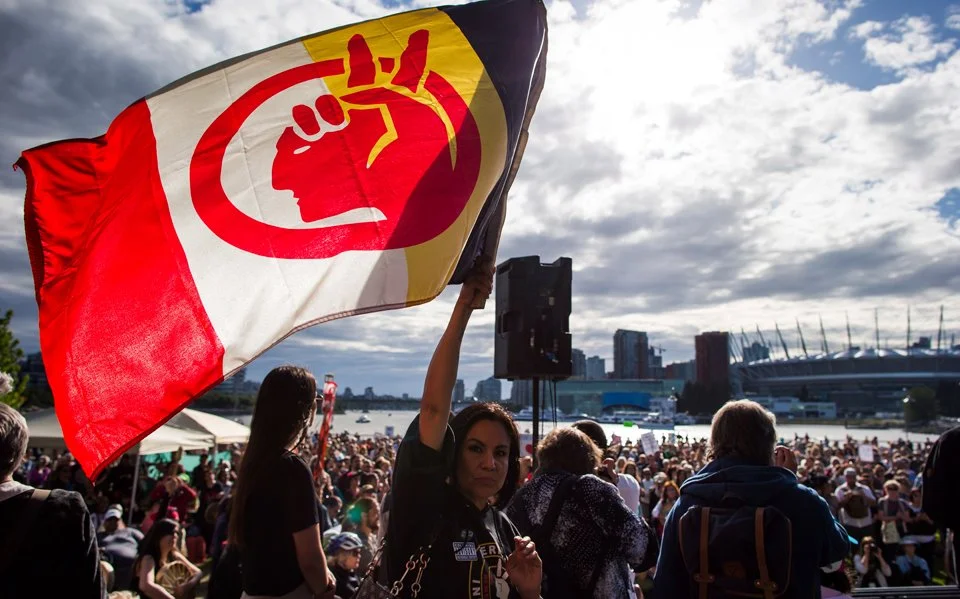
Flag of the American Indian Movement. Photo credit: Muscarelle Museum of Art
Native people sought justice, both through armed resistance, as well as in settler colonial courts where they achieved their own milestone case law precedents. Examples of land justice wins included the ruling that states have no authority over Tribal lands (Worcester v. Virginia - 1832) and that treaties reserved existing rights - they did not grant rights (United States v. Winans - 1905).
The 1970s held numerous land justice breakthroughs, including a case law reframing treaties as living land based law (U.S. v. Washington - 1974), the rise of the American Indian Movement which sought to address systemic issues and uphold Tribal sovereignty rights, and the Restoration Era where Tribes fought for the re-establishment of their federal status and land claims settlements.
Why the Land Back Movement is important
When a full transfer is completed, that action puts land under direct stewardship and ownership of Tribes or Native-led organizations and allows full autonomy for decisions on land, unlike with land held in trust. Land being returned to, or bought by Tribes, provides cultural, hands-on education for Native communities, food sovereignty, and community action towards the return of biodiversity to the ecosystems, healthy watersheds, wildfire resilience, and more.
The Land Back movement is a modern continuation of a broader history of land justice for Tribal communities. Land Back can be a spectrum from access and partnership to the full transfer of land. The process can involve various parties including private land owners, Tribes, state or federal agencies, land trusts, county or city officials, or Native-led organizations.
Right in our own backyard, we can be a witness in the upcoming years to the beneficial effects of traditional knowledge in ecological restoration through the efforts underway after the Klamath Dam removals. Within a year, there have been documented sightings of Chinook and Coho salmon in newly accessible tributaries, and the salmon are returning in numbers 30% greater in 2025 than in 2024. Land justice for tribal people results in ecological justice for the land and all its inhabitants as well.
What the Land Back Movement is NOT
The Land Back movement is not about forcibly removing settler descendants from their homes. It is about restoring a right relationship between land and the people who have tended the land for generations
The Land Back movement is not a single demand nor a one size fits all model
The movement is not anti-conservation. Making space for Indigenous people to care for and tend to the land often strengthens conservation outcomes and restores biodiversity.
Land Back is not about placing blame or landowner guilt. It is about engaging in responsible and transformative actions, for both people and the land.
Land Back examples in the PNW
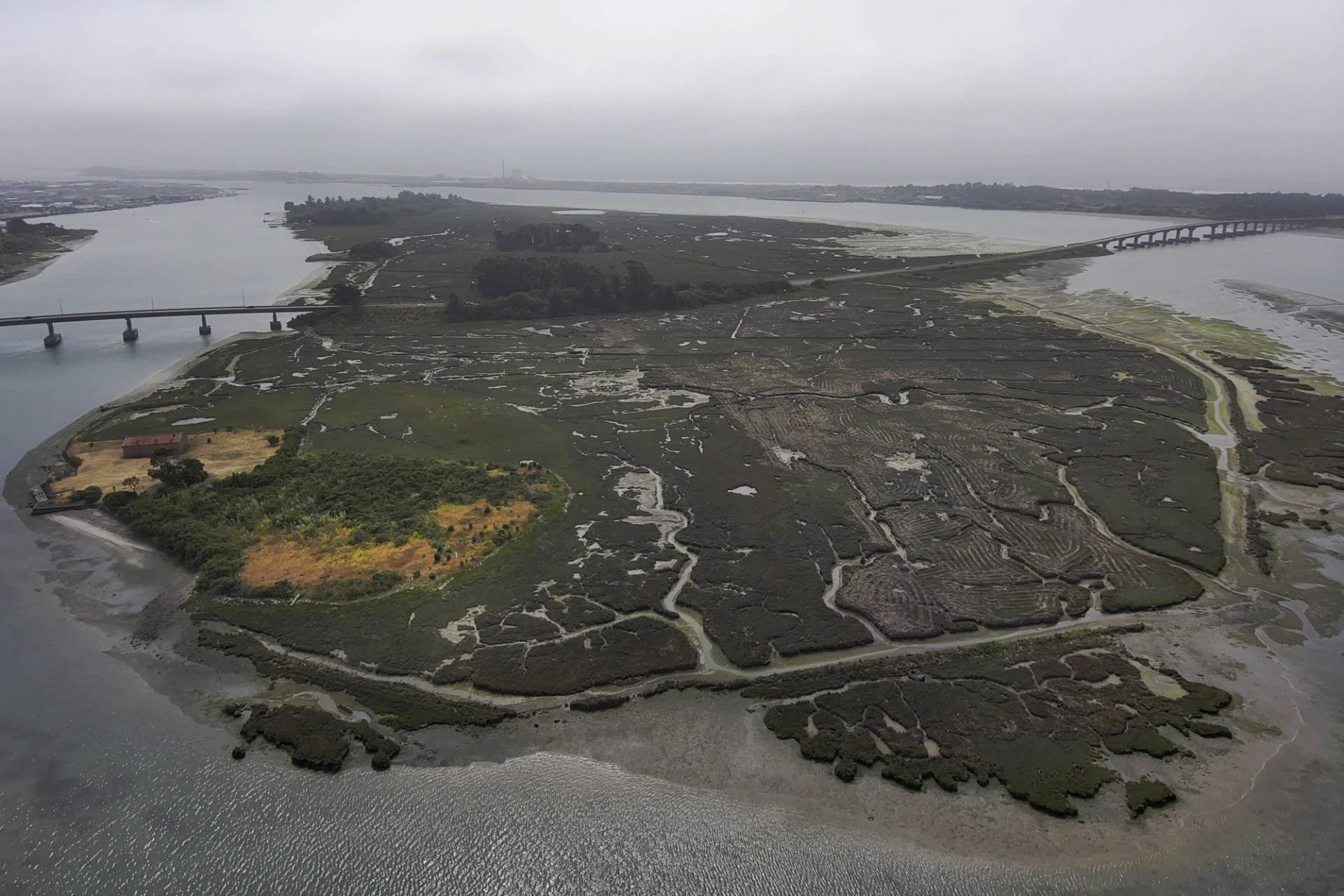
Wiyot Island. Photo Credit: Izzy Bloom/KQED
One of the earliest examples of Land Back occurred in Eureka, CA in 2004 when the city returned 40 acres of Tuluwat Island to the Wiyot people. This occurred after the Wiyot had purchased 1.5 acres of the island and engaged with volunteers and partnership organizations to organize a clean up of the toxic waste left by a sawmill and a boatyard. In 2018, the city council voted to relinquish the deed to the remaining 202 acres of the island, aside from a private inholding, to the Wiyot people.
Other land back wins include 10,000 acres purchased by the Hupa Tribe (California, 2023), 2,000 acres purchased by the Confederated Tribes of Siletz Indians (Oregon, 2025), 17,000 acres to the Tule Indian River Tribe (California, 2025) and the largest land return in California yet, 47,000 acres purchased by the Yurok Tribe (2025) with the support of several California conservation organizations.
An example of co-stewardship is the Qapqápa Wildlife Area where the Confederated Tribes of Umatilla co-manage over 11,000 acres of land with Oregon Department of Fish and Wildlife for First Foods gathering, restoration, monitoring, public and tribal use.
See the zoom Recording: Land Justice Panel Discussion
At Vesper Meadow, we see ourselves as participants in the healing of the land and through this, help reverse the recent history of dispossession, through reconnecting Tribal partners to place and supporting their self determined goals. We continue to engage in and work towards Land Back in all its forms.
See the discussion from the panel discussion, The Path to Justice: Tribal Voices on Land Back, recorded on Thursday, February 19th from 2pm - 4pm. We hear from Tribal members who have direct experience with land back and will share considerations for the process of transferring land, and how to respectfully engage towards land justice for Tribal communities.
Panel Speakers
Jerome Viles is enrolled at the Confederated Tribes of Siletz Indians. He was born and raised in Eugene, Oregon where he lives with his partner and child. Jerome has a passion for supporting the cultural revival of his people and is the founding executive director of Nvn-nes-'a Land Trust.
Rachel Cushman is an enrolled citizen of the Chinook Indian Nation, where she is both an elected and hereditary leader. In 2017, Cushman was elected to the Chinook Tribal Council, but her role as a leader stems from her ancestor, Clatsop Tyee Wasilta. Cushman is an Indigenous knowledge practitioner, activist, educator, and canoe skipper. For over 20 years, Cushman has fought to protect Chinook and Indigenous lands, waters, rights, and sovereignty.
Anna-Liza Victory is the Oregon Land Justice Project Manager at the Coalition of Oregon Land Trusts. She is a citizen of the Cherokee Nation and is also of German and Scotch-Irish descent. Through her role with the Oregon Land Justice Project, she works to build coalition and equitable partnerships between Tribal communities and conservation organizations across the state.
Frankie Myers is a Yurok Tribal member, currently serving his second and final term as Vice Chairman of the Yurok Tribe. He was born and raised on the Yurok Indian Reservation. Frankie has collaborated with a range of stakeholders including for-profit corporations, family farmers/ranchers, conservation groups, and tribal, state, and federal lawmakers.